Monday, May 16, 2016

The Power of Positive Thinking


Positive thinking is a mental and emotional attitude that focuses on the bright side of life and expects positive results.
A positive person anticipates happiness, health and success, and believes he or she can overcome any obstacle and difficulty.
Positive thinking is not accepted by everyone. Some, consider it as nonsense, and scoff at people who follow it, but there is a growing number of people, who accept positive thinking as a fact, and believe in its effectiveness.
It seems that this subject is gaining popularity, as evidenced by the many books, lectures and courses about it.
To use it in your life, you need more than just to be aware of its existence. You need to adopt the attitude of positive thinking in everything you do.

How Positive Thinking Works

The following story illustrates how this power works:
Allan applied for a new job, but he didn't believe he will get it, since his self-esteem was low, and he considered himself as a failure and unworthy of success.
He had a negative attitude toward himself, and therefore, believed that the other applicants were better and more qualified than him.
Allan's mind was occupied with negative thought and fears concerning the job, for the whole week preceding the job interview. He actually, anticipated failure.
On the day of the interview, he got up late, and to his horror he discovered that the shirt he planned to wear was dirty, and the other one needed ironing. As it was already too late, he went out wearing a wrinkled shirt and without eating breakfast.

Learn how to use the power of your imagination and visualization to achieve your dreams and goals, regardless of your current financial condition, the state of the economy, your circumstances and your education.
During the interview, he was tense, negative, hungry and worried about his shirt. All this, destroy his mind and made it difficult for him to focus on the interview. His overall behavior made a bad impression, and consequently, he materialized his fear and did not get the job.
Jim applied for the same job too, but approached the matter in a different way. He was sure that he was going to get the job. During the week preceding the interview, he often visualized himself making a good impression and getting the job.
In the evening before the interview, he prepared the clothes he was going to wear, and went to sleep a little earlier. On day of the interview, he woke up earlier than usual, and had ample time to eat breakfast, and then to arrive to the interview before the scheduled time.
Jim made a good impression and got the job.
What do we learn from these two stories? Was there any magic used? No, everything happened in a natural way.

Positive Thinking Is a Way of Life

With a positive attitude we experience pleasant and happy feelings. This brings brightness to the eyes, more energy, and happiness. Our whole being broadcasts good will, happiness and success. Even our health is affected in a beneficial way. We walk tall, our voice is more powerful, and our body language shows the way we feel.
Positive and negative thinking are contagious.
We affect, and are affected by the people we meet, in one way or another. This happens instinctively and on a subconscious level, through words, thoughts and feelings, and through body language.
Is it any wonder that we want to be around positive people, and prefer to avoid negative ones?
People are more disposed to help us, if we are positive, and they dislike and avoid anyone broadcasting negativity.
Negative thoughts, words and attitude, create negative and unhappy feelings, moods and behavior. When the mind is negative, poisons are released into the blood, which cause more unhappiness and negativity. This is the way to failure, frustration and disappointment.

Positive Thinking Instructions and Advice

In order to turn the mind toward the positive, some inner work is required, since attitude and thoughts do not change overnight.
  1. Read about this subject, think about its benefits, and persuade yourself to try it. The power of your thoughts is a mighty power that is always shaping your life. This shaping is usually done subconsciously, but it is possible to make the process a conscious one. Even if the idea seems strange, give it a try. You have nothing to lose, but only to gain.
  2. Ignore what other people say or think about you, if they discover that you are changing the way you think.
  3. Use your imagination to visualize only favorable and beneficial situations.
  4. Use positive words in your inner dialogues, or when talking with others.
  5. Smile a little more, as this helps to think positively.
  6. Once a negative thought enters your mind, you have to be aware of it, and endeavor to replace it with a constructive one. If the negative thought returns, replace it again with a positive one. It is as if there are two pictures in front of you, and you have to choose to look at one of them, and disregard the other. Persistence will eventually teach your mind to think positively, and to ignore negative thoughts.
  7. In case you experience inner resistance and difficulties when replacing negative thoughts with positive ones, do not give up, but keep looking only at the beneficial, good and happy thoughts in your mind.
  8. It doesn't matter what your circumstances are at the present moment. Think positively, expect only favorable results and situations, and circumstances will change accordingly. If you persevere, you will transform the way your mind thinks. It might take some time for the changes to take place, but eventually they will.

Friday, May 13, 2016

The Power of Positive Attitude Can Change Your Life


A Positive Attitude Leads to Success and Happiness.

A positive attitude helps you cope more easily with the daily affairs of life. It brings optimism into your life, and makes it easier to avoid worries and negative thinking. If you adopt it as a way of life, it would bring constructive changes into your life, and makes them happier, brighter and more successful.
With a positive attitude you see the bright side of life, become optimistic, and expect the best to happen. It is certainly a state of mind that is well worth developing.
Positive attitude manifests in the following ways:
  • Positive thinking.
  • Constructive thinking.
  • Creative thinking.
  • Optimism.
  • Motivation and energy to do things and accomplish goals.
  • An attitude of happiness.
A positive frame of mind can help you in many ways, such as:
  • Expecting success and not failure.
  • Making you feel inspired.
  • It gives you the strength not to give up, if you encounter obstacles on your way.
  • It makes you look at failure and problems as blessings in disguise.
  • Believing in yourself and in your abilities.>
  • Enables you to show self-esteem and confidence.
  • You look for solutions, instead of dwelling on problems.
  • You see and recognize opportunities.
A positive attitude leads to happiness and success and can change your whole life. If you look at the bright side of life, your whole life becomes filled with light. This light affects not only you and the way you look at the world, but it also affects your environment and the people around you.
If this attitude is strong enough, it becomes contagious. It's as if you radiate light around you.

More Benefits of a Positive Attitude:

This might seem like a repetition of the above, but it helps to make this message clearer.
  • It helps you achieve goals and attain success.
  • It brings more happiness into your life.
  • It produces more energy.
  • Positive attitude increases your faith in your abilities, and brings hope for a brighter future.
  • You become able to inspire and motivate yourself and others.
  • You encounter fewer obstacles and difficulties in your daily life.
  • You get more respect and love from people.
  • Life smiles at you.
Negative attitude says: you cannot achieve success.
Positive attitude says: You can achieve success.
If you have been exhibiting a negative attitude and expecting failure and difficulties, it is now the time to change the way you think. It is the time to get rid of negative thoughts and behavior, and start leading a happier and more successful life. If you tried to do so in the past and failed, it only means that you have not tried enough.

Simple Tips for Developing a Positive Attitude:

  1. Choose to be happy. Yes, it is a matter of choice. When negative thoughts enter your mind, just refuse to look at them, doing your best to substitute them with happy thoughts
  2. Look at the bright side of life. It's a matter of choice and repeated attempts.
  3. Choose to be optimistic.
  4. Find reasons to smile more often. You can find such reasons, if you search for them.
  5. Have faith in yourself, and believe that the Universe can help you.
  6. Associate yourself with happy people.
  7. Read inspiring stories.
  8. Read inspiring quotes.
Following even only one of the above suggestions, will bring more light into your life!

Thursday, April 7, 2016

                                Aristotle

                                                
Introduction: Aristotle’s Definition of Happiness
“Happiness depends on ourselves.” More than anybody else, Aristotle enshrines happiness as a central purpose of human life and a goal in itself. As a result he devotes more space to the topic of happiness than any thinker prior to the modern era. Living during the same period as Mencius, but on the other side of the world, he draws some similar conclusions. That is, happiness depends on the cultivation of virtue, though his virtues are somewhat more individualistic than the essentially social virtues of the Confucians. Yet as we shall see, Aristotle was convinced that a genuinely happy life required the fulfillment of a broad range of conditions, including physical as well as mental well-being. In this way he introduced the idea of a science of happiness in the classical sense, in terms of a new field of knowledge.
Essentially, Aristotle argues that virtue is achieved by maintaining the Mean, which is the balance between two excesses. Aristotle’s doctrine of the Mean is reminiscent of Buddha’s Middle Path, but there are intriguing differences. For Aristotle the mean was a method of achieving virtue, but for Buddha the Middle Path referred to a peaceful way of life which negotiated the extremes of harsh asceticism and sensual pleasure seeking. The Middle Path was a minimal requirement for the meditative life, and not the source of virtue in itself.
                                                                                Aristotle: A Little Background
Aristotle (right) and Plato in Raphael's painting, 'The School of Athens', in the Vatican.
    
Aristotle (right) and Plato in Raphael’s fresco, ‘The School of Athens’, in the Apostolic Palace in the Vatican.
Aristotle is one of the greatest thinkers in the history of western science and philosophy, making contributions to logic, metaphysics, mathematics, physics, biology, botany, ethics, politics, agriculture, medicine, dance and theatre. He was a student of Plato who in turn studied under Socrates. Although we do not actually possess any of Aristotle’s own writings intended for publication, we have volumes of the lecture notes he delivered for his students; through these Aristotle was to exercise his profound influence through the ages. Indeed, the medieval outlook is sometimes considered to be the “Aristotelian worldview” and St. Thomas Aquinas simply refers to Aristotle as “The Philosopher” as though there were no other.
Aristotle was the first to classify areas of human knowledge into distinct disciplines such as mathematics, biology, and ethics. Some of these classifications are still used today, such as the species-genus system taught in biology classes. He was the first to devise a formal system for reasoning, whereby the validity of an argument is determined by its structure rather than its content. Consider the following syllogism: All men are mortal; Socrates is a man; therefore, Socrates is mortal. Here we can see that as long as the premises are true, the conclusion must also be true, no matter what we substitute for “men or “is mortal.” Aristotle’s brand of logic dominated this area of thought until the rise of modern symbolic logic in the late 19th Century.
Aristotle was the founder of the Lyceum, the first scientific institute, based in Athens, Greece. Along with his teacher Plato, he was one of the strongest advocates of a liberal arts education, which stresses the education of the whole person, including one’s moral character, rather than merely learning a set of skills. According to Aristotle, this view of education is necessary if we are to produce a society of happy as well as productive individuals.
Happiness as the Ultimate Purpose of Human Existence
One of Aristotle’s most influential works is the Nicomachean Ethics, where he presents a theory of happiness that is still relevant today, over 2,300 years later. The key question Aristotle seeks to answer in these lectures is “What is the ultimate purpose of human existence?” What is that end or goal for which we should direct all of our activities? Everywhere we see people seeking pleasure, wealth, and a good reputation. But while each of these has some value, none of them can occupy the place of the chief good for which humanity should aim. To be an ultimate end, an act must be self-sufficient and final, “that which is always desirable in itself and never for the sake of something else” (Nicomachean Ethics, 1097a30-34), and it must be attainable by man. Aristotle claims that nearly everyone would agree that happiness is the end which meets all these requirements. It is easy enough to see that we desire money, pleasure, and honor only because we believe that these goods will make us happy. It seems that all other goods are a means towards obtaining happiness, while happiness is always an end in itself.
The Greek word that usually gets translated as “happiness” is eudaimonia, and like most translations from ancient languages, this can be misleading. The main trouble is that happiness (especially in modern America) is often conceived of as a subjective state of mind, as when one says one is happy when one is enjoying a cool beer on a hot day, or is out “having fun” with one’s friends. For Aristotle, however, happiness is a final end or goal that encompasses the totality of one’s life. It is not something that can be gained or lost in a few hours, like pleasurable sensations. It is more like the ultimate value of your life as lived up to this moment, measuring how well you have lived up to your full potential as a human being. For this reason, one cannot really make any pronouncements about whether one has lived a happy life until it is over, just as we would not say of a football game that it was a “great game” at halftime (indeed we know of many such games that turn out to be blowouts or duds). For the same reason we cannot say that children are happy, any more than we can say that an acorn is a tree, for the potential for a flourishing human life has not yet been realized. As Aristotle says, “for as it is not one swallow or one fine day that makes a spring, so it is not one day or a short time that makes a man blessed and happy.” (Nicomachean Ethics, 1098a18)
The Hierarchical View of Nature
In order to explain human happiness, Aristotle draws on a view of nature he derived from his biological investigations. If we look at nature, we notice that there are four different kinds of things that exist in the world, each one defined by a different purpose:
Mineral: rocks, metals and other lifeless things. The only goal which these things seek is to come to a rest. They are “beyond stupid” since they are inanimate objects with no soul
Vegetative: plants and other wildlife. Here we see a new kind of thing emerge,something which is alive. Because plants seek nourishment and growth, they have souls and can be even said to be satisfied when they attain these goals
Animal: all the creatures we study as belonging to the animal kingdom. Here we see a higher level of life emerge: animals seek pleasure and reproduction, and we can talk about a happy or sad dog, for example, to the extent that they are healthy and lead a pleasant life
Human: what is it that makes human beings different from the rest of the animal kingdom? Aristotle answers: Reason. Only humans are capable of acting according to principles, and in so doing taking responsibility for their choices. We can blame Johnny for stealing the candy since he knows it is wrong, but we wouldn’t blame an animal since it doesn’t know any better.
It seems that our unique function is to reason: by reasoning things out we attain our ends, solve our problems, and hence live a life that is qualitatively different in kind from plants or animals. The good for a human is different from the good for an animal because we have different capacities or potentialities. We have a rational capacity and the exercising of this capacity is thus the perfecting of our natures as human beings. For this reason, pleasure alone cannot constitute human happiness, for pleasure is what animals seek and human beings have higher capacities than animals. The goal is not to annihilate our physical urges, however, but rather to channel them in ways that are appropriate to our natures as rational animals.
Thus Aristotle gives us his definition of happiness:
…the function of man is to live a certain kind of life, and this activity implies a rational principle, and the function of a good man is the good and noble performance of these, and if any action is well performed it is performed in accord with the appropriate excellence: if this is the case, then happiness turns out to be an activity of the soul in accordance with virtue. (Nicomachean Ethics, 1098a13)
The Pursuit of Happiness as the Exercise of Virtue
In this last quote we can see another important feature of Aristotle’s theory: the link between the concepts of happiness and virtue. Aristotle tells us that the most important factor in the effort to achieve happiness is to have a good moral character — what he calls “complete virtue.” But being virtuous is not a passive state: one must act in accordance with virtue. Nor is it enough to have a few virtues; rather one must strive to possess all of them. As Aristotle writes,
He is happy who lives in accordance with complete virtue and is sufficiently equipped with external goods, not for some chance period but throughout a complete life. (Nicomachean Ethics, 1101a10)
According to Aristotle, happiness consists in achieving, through the course of a whole lifetime, all the goods — health, wealth, knowledge, friends, etc. — that lead to the perfection of human nature and to the enrichment of human life. This requires us to make choices, some of which may be very difficult. Often the lesser good promises immediate pleasure and is more tempting, while the greater good is painful and requires some sort of sacrifice. For example, it may be easier and more enjoyable to spend the night watching television, but you know that you will be better off if you spend it researching for your term paper. Developing a good character requires a strong effort of will to do the right thing, even in difficult situations.
Another example is the taking of drugs, which is becoming more and more of a problem in our society today. For a fairly small price, one can immediately take one’s mind off of one’s troubles and experience deep euphoria by popping an oxycontin pill or snorting some cocaine. Yet, inevitably, this short-term pleasure will lead to longer term pain. A few hours later you may feel miserable and so need to take the drug again, which leads to a never-ending spiral of need and relief. Addiction inevitably drains your funds and provides a burden to your friends and family. All of those virtues — generosity, temperance, friendship, courage, etc. — that make up the good life appear to be conspicuously absent in a life of drug use.
Aristotle would be strongly critical of the culture of “instant gratification” which seems to predominate in our society today. In order to achieve the life of complete virtue, we need to make the right choices, and this involves keeping our eye on the future, on the ultimate result we want for our lives as a whole. We will not achieve happiness simply by enjoying the pleasures of the moment. Unfortunately, this is something most people are not able to overcome in themselves. As he laments, “the mass of mankind are evidently quite slavish in their tastes, preferring a life suitable to beasts”
archer-&-target2(Nicomachean Ethics, 1095b 20). Later in the Ethics Aristotle draws attention to the concept of akrasia, or weakness of the will. In many cases the overwhelming prospect of some great pleasure obscures one’s perception of what is truly good. Fortunately, this natural disposition is curable through training, which for Aristotle meant education and the constant aim to perfect virtue. As he puts it, a clumsy archer may indeed get better with practice, so long as he keeps aiming for the target.
Note also that it is not enough to think about doing the right thing, or even intend to do the right thing: we have to actually do it. Thus, it is one thing to think of writing the great American novel, another to actually write it. When we impose a form and order upon all those letters to actually produce a compelling story or essay, we are manifesting our rational potential, and the result of that is a sense of deep fulfillment. Or to take another example, when we exercise our citizenship by voting, we are manifesting our rational potential in yet another way, by taking responsibility for our community. There are myriad ways in which we can exercise our latent virtue in this way, and it would seem that the fullest attainment of human happiness would be one which brought all these ways together in a comprehensive rational life-plan.
There is yet another activity few people engage in which is required to live a truly happy life, according to Aristotle: intellectual contemplation. Since our nature is to be rational, the ultimate perfection of our natures is rational reflection. This means having an intellectual curiosity which perpetuates that natural wonder to know which begins in childhood but seems to be stamped out soon thereafter. For Aristotle, education should be about the cultivation of character, and this involves a practical and a theoretical component. The practical component is the acquisition of a moral character, as discussed above. The theoretical component is the making of a philosopher. Here there is no tangible reward, but the critical questioning of things raises our minds above the realm of nature and closer to the abode of the gods.
Friendship
For Aristotle, friendship is one of the most important virtues in achieving the goal of eudaimonia (happiness). While there are different kinds of friendship, the highest is one that is based on virtue (arête). This type of friendship is based on a person wishing the best for their friends regardless of utility or pleasure. Aristotle calls it a “… complete sort of friendship between people who are good and alike in virtue …” (Nicomachean Ethics, 1156b07-08). This type of friendship is long lasting and tough to obtain because these types of people are hard to come by and it takes a lot of work to have a complete, virtuous friendship. Aristotle notes that one cannot have a large number of friends because of the amount of time and care that a virtuous friendship requires. Aristotle values friendship so highly that he argues friendship supersedes justice and honor. First of all, friendship seems to be so valued by people that no one would choose to live without friends. People who value honor will likely seek out either flattery or those who have more power than they do, in order that they may obtain personal gain through these relationships. Aristotle believes that the love of friendship is greater than this because it can be enjoyed as it is. “Being loved, however, people enjoy for its own sake, and for this reason it would seem it is something better than being honoured and that friendship is chosen for its own sake” (Nicomachean Ethics, 1159a25-28). The emphasis on enjoyment here is noteworthy: a virtuous friendship is one that is most enjoyable since it combines pleasure and virtue together, thus fulfilling our emotional and intellectual natures.
The Golden Mean
Aristotle’s ethics is sometimes referred to as “virtue ethics” since its focus is not on the moral weight of duties or obligations, but on the development of character and the acquiring of virtues such as courage, justice, temperance, benevolence, and prudence. And anyone who knows anything about Aristotle has heard his doctrine of virtue as being a “golden mean” between the extremes of excess and deficiency. Courage, for example, is a mean regarding the feeling of fear, between the deficiency of rashness (too little fear) and the excess of cowardice (too much fear). Justice is a mean between getting or giving too much and getting or giving too little. Benevolence is a mean between giving to people who don’t deserve it and not giving to anyone at all. Aristotle is not recommending that one should be moderate in all things, since one should at all times exercise the virtues. One can’t reason “I should be cruel to my neighbor now since I was too nice to him before.” The mean is a mean between two vices, and not simply a mean between too much and too little.
Furthermore, the mean is “relative to ourselves,” indicating that one person’s mean may be another person’s extreme. Milo the wrestler, as Aristotle puts it, needs more gruel than a normal person, and his mean diet will vary accordingly. Similarly for the moral virtues. Aristotle suggests that some people are born with weaker wills than others; for these people, it may actually be a mean to flee in battle (the extremes being to get slaughtered or commit suicide). Here we see the flexibility in Aristotle’s account: as soon as he begins to lay down some moral rules, he relaxes them in order to take into consideration the variety and contingency of particular temperaments.
Aristotle’s doctrine of the mean is well in keeping with ancient ways of thinking which conceived of justice as a state of equilibrium between opposing forces. In the early cosmologies, the Universe is stabilized as a result of the reconciliation between the opposing forces of Chaos and Order. The Greek philosopher Heraclitus conceived of right living as acting in accordance with the Logos, the principle of the harmony of opposites; and Plato defined justice in the soul as the proper balance among its parts. Like Plato, Aristotle thought of the virtuous character along the lines of a healthy body. According to the prevailing medical theory of his day, health in the body consists of an appropriate balance between the opposing qualities of hot, cold, the dry, and the moist. The goal of the physician is to produce a proper balance among these elements, by specifying the appropriate training and diet regimen, which will of course be different for every person.
Similarly with health in the soul: exhibiting too much passion may lead to reckless acts of anger or violence which will be injurious to one’s mental well-being as well as to others; but not showing any passion is a denial of one’s human nature and results in the sickly qualities of morbidity, dullness, and antisocial behavior. The healthy path is the “middle path,” though remember it is not exactly the middle, given that people who are born with extremely passionate natures will have a different mean than those with sullen, dispassionate natures. Aristotle concludes that goodness of character is “a settled condition of the soul which wills or chooses the mean relatively to ourselves, this mean being determined by a rule or whatever we like to call that by which the wise man determines it.” (Nicomachean Ethics, 1006b36)
Conclusion
In conclusion, according to Aristotle, what is happiness?
  • Happiness is the ultimate end and purpose of human existence
  • Happiness is not pleasure, nor is it virtue. It is the exercise of virtue.
  • Happiness cannot be achieved until the end of one’s life. Hence it is a goal and not a temporary state.
  • Happiness is the perfection of human nature. Since man is a rational animal, human happiness depends on the exercise of his reason.
  • Happiness depends on acquiring a moral character, where one displays the virtues of courage, generosity, justice, friendship, and citizenship in one’s life. These virtues involve striking a balance or “mean” between an excess and a deficiency.
  • Happiness requires intellectual contemplation, for this is the ultimate realization of our rational capacities.

Friday, April 1, 2016

Aristotle:

 Image result for aristotle pictures

 Forms and Souls

Metaphysics

Aristotle considered the most fundamental features of reality in the twelve books of the Μεταφυσικη (Metaphysics). Although experience of what happens is a key to all demonstrative knowledge, Aristotle supposed that the abstract study of "being qua being" must delve more deeply, in order to understand why things happen the way they do. A quick review of past attempts at achieving this goal reveals that earlier philosophers had created more difficult questions than they had answered: the Milesians over-emphasized material causes; Anaxagoras over-emphasized mind; and Plato got bogged down in the theory of forms. Aristotle intended to do better.
Although any disciplined study is promising because there is an ultimate truth to be discovered, the abstractness of metaphysical reasoning requires that we think about the processes we are employing even as we use them in search of that truth. As always, Aristotle assumed that the structure of language and logic naturally mirrors the way things really are. Thus, the major points of each book are made by carefully analyzing our linguistic practices as a guide to the ultimate nature of what is.

Fundamental Truths

It is reasonable to begin, therefore, with the simplest rules of logic, which embody the most fundamental principles applying to absolutely everything that is:
The Law of Non-Contradiction in logic merely notes that no assertion is both true and false, but applied to reality this simple rule entails that nothing can both "be . . . " and "not be . . . " at the same time, although we will of course want to find room to allow for things to change. Thus, neither strict Protagorean relativism nor Parmenidean immutability offer a correct account of the nature of reality. (Metaphysics IV 3-6)
The Law of Excluded Middle in logic states the necessity that either an assertion or its negation must be true, and this entails that there is no profound indeterminacy in the realm of reality. Although our knowledge of an assertion may sometimes fall short of what we need in order to decide whether it is true or false, we can be sure that either it or its negation is true. (Metaphysics IV 7-8)
In order to achieve its required abstract necessity, all of metaphysics must be constructed from similar principles. Aristotle believed this to be the case because metaphysics is concerned with a genuinely unique subject matter. While natural science deals with moveable, separable things and mathematics focusses upon immoveable, inseparable things, metaphysics (especially in its highest, most abstract varieties) has as its objects only things that are both immoveable and separable. Thus, what we learn in metaphysics is nothing less than the immutable eternal nature, or essence, of individual things.

Universals

In the central books of the Metaphysics, Aristotle tried to develop an adequate analysis of subject-predicate judgments. Since logic and language rely heavily upon the copulative use of "is," careful study of these uses should reveal the genuine relationship that holds between substances and their features. Of course, Plato had already offered an extended account of this relationship, emphasizing the reality of the abstract forms rather than their material substratum.
But Aristotle argued that the theory of forms is seriously flawed: it is not supported by good arguments; it requires a form for each thing; and it is too mathematical. Worst of all, on Aristotle's view, the theory of forms cannot adequately explain the occurrence of change. By identifying the thing with its essence, the theory cannot account for the generation of new substances. (Metaphysics VII) A more reasonable position must differentiate between matter and form and allow for a dynamic relation between the two.
Aristotle therefore maintained that each individual substance is a hylomorphic composite involving both matter and form together. Ordinary predication, then, involves paronymously attributing an abstract universal of a concrete individual, and our experience of this green thing is more significant than our apprehension of the form of greenness. This account, with its emphasis on the particularity of individual substances, provided Aristotle with a firm foundation in practical experience.

Higher Truths

Aristotle also offered a detailed account of the dynamic process of change. A potentiality {Gk. δυναμις [dynamis]} is either the passive capacity of a substance to be changed or (in the case of animate beings) its active capacity to produce change in other substances in determinate ways. An actuality {Gk. ενεργεια [energeia]} is just the realization of one of these potentialities, which is most significant when it includes not merely the movement but also its purpose. Becoming, then, is the process in which the potentiality present in one individual substance is actualized through the agency of something else which is already actual. (Metaphysics IX) Thus, for Aristotle, change of any kind requires the actual existence of something which causes the change.
The higher truths of what Aristotle called "theology" arise from an application of these notions to the more purely speculative study of being qua being. Since every being is a composite whose form and matter have been brought together by some cause, and since there cannot be infinitely many such causes, he concluded that everything that happens is ultimately attributable to a single universal cause, itself eternal and immutable. (Metaphysics XII 6) This self-caused "first mover," from which all else derives, must be regarded as a mind, whose actual thinking is its whole nature. The goodness of the entire universe, Aristotle supposed, resides in its teleological unity as the will of a single intelligent being.

The Nature of Souls

According to Aristotle, every animate being is a living thing which can move itself only because it has a soul. Animals and plants, along with human beings, are more like each other than any of them are like any inanimate object, since each of them has a soul. Thus, his great treatise on psychology, On The Soul, offers interconnected explanations for the functions and operations of all living organisms.
All such beings, on Aristotle's view, have a nutritive soul which initiates and guides their most basic functions, the absorption of food, growth, and reproduction of its kind. All animals (and perhaps some plants) also have a sensitive soul by means of which they perceive features of their surroundings and move in response to the stimuli this provides. Human beings also possess (in addition to the rest) a rational soul that permits representation and thought. (On the Soul II 2)
Notice that each living thing has just one soul, the actions of which exhibit some degree of nutritive, sensitive, and/or rational functioning. This soul is the formal, efficient, and final cause of the existence of the organism; only its material cause resides purely in the body. Thus, all of the operations of the organism are to be explained in terms of the functions of its soul.

Human Knowledge

Sensation is the passive capacity for the soul to be changed through the contact of the associated body with external objects. In each variety of sensation, the normal operations of the appropriate organ of sense result in the soul's becoming potentially what the object is in actuality. Thus, without any necessary exchange of matter, the soul takes on the form of the object: when I feel the point of a pin, its shape makes an impression on my finger, conveying this form to my sensitive soul (resulting in information). (On the Soul II 5)
Thought is the more active process of engaging in the manipulation of forms without any contact with external objects at all. Thus, thinking is potentially independent of the objects of thought, from which it abstracts the form alone. Even the imagination, according to Aristotle, involves the operation of the common sense without stimulation by the sensory organs of the body. Hence, although all knowledge must begin with information acquired through the senses, its results are achieved by rational means. Transcending the sensory preoccupation with particulars, the soul employs the formal methods of logic to cognize the relationships among abstract forms. (On the Soul III 4)
Desire is the origin of movement toward some goal. Every animate being, to some degree, is capable of responding to its own internal states and those of its external environment in such a way as to alleviate the felt absence or lack of some pleasure or the felt presence of some pain. Even actions taken as a result of intellectual deliberation, Aristotle supposed, produce motion only through the collateral evocation of a concrete desire. (On the Soul III 10)

PLATO'S THEORY


The Allegory of the Cave

  1. Plato realizes that the general run of humankind can think, and speak, etc., without (so far as they acknowledge) any awareness of his realm of Forms.
  2. The allegory of the cave is supposed to explain this.
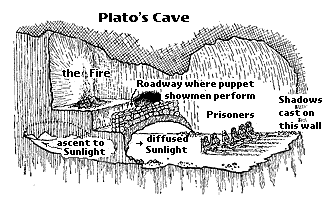
  3. In the allegory, Plato likens people untutored in the Theory of Forms to prisoners chained in a cave, unable to turn their heads. All they can see is the wall of the cave. Behind them burns a fire.  Between the fire and the prisoners there is a parapet, along which puppeteers can walk. The puppeteers, who are behind the prisoners, hold up puppets that cast shadows on the wall of the cave. The prisoners are unable to see these puppets, the real objects, that pass behind them. What the prisoners see and hear are shadows and echoes cast by objects that they do not see. Here is an illustration of Plato’s Cave:
    From Great Dialogues of Plato (Warmington and Rouse, eds.) New York, Signet Classics: 1999. p. 316.
  4. Such prisoners would mistake appearance for reality. They would think the things they see on the wall (the shadows) were real; they would know nothing of the real causes of the shadows.
  5. So when the prisoners talk, what are they talking about? If an object (a book, let us say) is carried past behind them, and it casts a shadow on the wall, and a prisoner says “I see a book,” what is he talking about? He thinks he is talking about a book, but he is really talking about a shadow. But he uses the word “book.” What does that refer to?
  6. Plato gives his answer at line (515b2). The text here has puzzled many editors, and it has been frequently emended. The translation in Grube/Reeve gets the point correctly:
    And if they could talk to one another, don’t you think they’d suppose that the names they used applied to the things they see passing before them?”
  7. Plato’s point is that the prisoners would be mistaken. For they would be taking the terms in their language to refer to the shadows that pass before their eyes, rather than (as is correct, in Plato’s view) to the real things that cast the shadows. If a prisoner says “That’s a book” he thinks that the word “book” refers to the very thing he is looking at. But he would be wrong. He’s only looking at a shadow. The real referent of the word “book” he cannot see. To see it, he would have to turn his head around.
  8. Plato’s point: the general terms of our language are not “names” of the physical objects that we can see. They are actually names of things that we cannot see, things that we can only grasp with the mind.
  9. When the prisoners are released, they can turn their heads and see the real objects. Then they realize their error. What can we do that is analogous to turning our heads and seeing the causes of the shadows? We can come to grasp the Forms with our minds.
  10. Plato’s aim in the Republic is to describe what is necessary for us to achieve this reflective understanding. But even without it, it remains true that our very ability to think and to speak depends on the Forms. For the terms of the language we use get their meaning by “naming” the Forms that the objects we perceive participate in.
  11. The prisoners may learn what a book is by their experience with shadows of books. But they would be mistaken if they thought that the word “book” refers to something that any of them has ever seen. Likewise, we may acquire concepts by our perceptual experience of physical objects. But we would be mistaken if we thought that the concepts that we grasp were on the same level as the things we perceive.

Wednesday, March 30, 2016

           Plato: Ethics - The Ring of Gyges

                                                                                                                                                                                                                Are you a decent person?
  Well, what if you suddenly gained incredible power?
  Are humans inherently selfish?
  Are we inherently compassionate?
Plato provides a thought-experiment that can tell us much about our ideas of human nature, including our own. In the Republic, he has the character Glaucon pose a challenge to Socrates. They have been discussing the question "What is Justice?" Socrates has refuted Thrasymachus who insisted that "Justice is the interest of the stronger" or might is right. Now, young Glaucon continues the issue by questioning how genuine any human being's commitment to justice actually is. The story he tells acts as a thought-experiment. The question at issue being: do humans naturally tend to justice or injustice? When you read the below excerpt, you may be reminded of another story of good, evil, and a ring of invisibility. Tolkien's story of how a ring with magic power led to the corruption of those who owned it has obvious connections to Plato's story.


 They say that to do injustice is, by nature, good; to suffer injustice, evil; but that the evil is greater than the good. And so when men have both done and suffered injustice and have had experience of both, not being able to avoid the one and obtain the other, they think that they had better agree among themselves to have neither; hence there arise laws and mutual covenants; and that which is ordained by law is termed by them lawful and just. This they affirm to be the origin and nature of justice; --it is a mean or compromise, between the best of all, which is to do injustice and not be punished, and the worst of all, which is to suffer injustice without the power of retaliation; and justice, being at a middle point between the two, is tolerated not as a good, but as the lesser evil, and honoured by reason of the inability of men to do injustice. For no man who is worthy to be called a man would ever submit to such an agreement if he were able to resist; he would be mad if he did. Such is the received account, Socrates, of the nature and origin of justice.
Now that those who practice justice do so involuntarily and because they have not the power to be unjust will best appear if we imagine something of this kind: having given both to the just and the unjust power to do what they will, let us watch and see whither desire will lead them; then we shall discover in the very act the just and unjust man to be proceeding along the same road, following their interest, which all natures deem to be their good, and are only diverted into the path of justice by the force of law. The liberty which we are supposing may be most completely given to them in the form of such a power as is said to have been possessed by Gyges the ancestor of Croesus the Lydian. According to the tradition, Gyges was a shepherd in the service of the king of Lydia; there was a great storm, and an earthquake made an opening in the earth at the place where he was feeding his flock. Amazed at the sight, he descended into the opening, where, among other marvels, he beheld a hollow brazen horse, having doors, at which he stooping and looking in saw a dead body of stature, as appeared to him, more than human, and having nothing on but a gold ring; this he took from the finger of the dead and re ascended. Now the shepherds met together, according to custom, that they might send their monthly report about the flocks to the king; into their assembly he came having the ring on his finger, and as he was sitting among them he chanced to turn the collet of the ring inside his hand, when instantly he became invisible to the rest of the company and they began to speak of him as if he were no longer present. He was astonished at this, and again touching the ring he turned the collet [decorative front of the ring] outwards and reappeared; he made several trials of the ring, and always with the same result-when he turned the collet inwards he became invisible, when outwards he reappeared. Whereupon he contrived to be chosen one of the messengers who were sent to the court; where as soon as he arrived he seduced the queen, and with her help conspired against the king and slew him, and took the kingdom. Suppose now that there were two such magic rings, and the just put on one of them and the unjust the other; no man can be imagined to be of such an iron nature that he would stand fast in justice. No man would keep his hands off what was not his own when he could safely take what he liked out of the market, or go into houses and lie with any one at his pleasure, or kill or release from prison whom he would, and in all respects be like a God among men. Then the actions of the just would be as the actions of the unjust; they would both come at last to the same point. And this we may truly affirm to be a great proof that a man is just, not willingly or because he thinks that justice is any good to him individually, but of necessity, for wherever any one thinks that he can safely be unjust, there he is unjust. For all men believe in their hearts that injustice is far more profitable to the individual than justice, and he who argues as I have been supposing, will say that they are right. If you could imagine any one obtaining this power of becoming invisible, and never doing any wrong or touching what was another's, he would be thought by the lookers-on to be a most wretched idiot, although they would praise him to one another's faces, and keep up appearances with one another from a fear that they too might suffer injustice."
This story remains important to us today because it concerns what we can expect humans to do with power over others. In politics, we give power to others, hoping that they will do what is right. If Plato's allegory of the ring is right, then we had better watch out. Anyone who gains power without accountability is liable to use it unjustly. This particularly significant right now as the U.S. and U. K. governments are increasing the secrecy of their actions and gaining increased power over public information such as news. Secrecy is a form of invisibility, and for the purposes of power, as effective as a magic ring. The question "What is Justice?" remains as crucial today as it did 2,400 years ago.

Saturday, March 5, 2016

HOW TO DISCOVER THE REASON FOR YOUR EXISTENCE

HOW TO DISCOVER THE REASON FOR YOUR EXISTENCE
  How do you discover your real purpose in life? I’m not talking about your job, your daily responsibilities, or even your long-term goals. I mean the real reason why you’re here at all — the very reason you exist.
Perhaps you’re a rather wonderfull person who doesn’t believe you have a purpose and that life has no meaning. Doesn’t matter. Not believing that you have a purpose won’t prevent you from discovering it, just as a lack of belief in gravity won’t prevent you from tripping. All that a lack of belief will do is make it take longer. Most likely though if you don’t believe you have a purpose, then you probably won’t believe what I’m saying anyway, but even so, what’s the risk of investing an hour just in case?
Here’s a story about Bruce Lee which sets the stage for this little exercise. A master martial artist asked Bruce to teach him everything Bruce knew about martial arts. Bruce held up two cups, both filled with liquid. “The first cup,” said Bruce, “represents all of your knowledge about martial arts. The second cup represents all of my knowledge about martial arts. If you want to fill your cup with my knowledge, you must first empty your cup of your knowledge.”
If you want to discover your true purpose in life, you must first empty your mind of all the false purposes you’ve been taught (including the idea that you may have no purpose at all).
So how to discover your purpose in life? While there are many ways to do this, some of them fairly involved, here is one of the simplest that anyone can do. The more open you are to this process, and the more you expect it to work, the faster it will work for you. But not being open to it or having doubts about it or thinking it’s an entirely idiotic and meaningless waste of time won’t prevent it from working as long as you stick with it — again, it will just take longer to converge.
Here’s what to do:
  1. Take out a blank sheet of paper or open up a word processor where you can type (I prefer the latter because it’s faster).
  2. Write at the top, “What is my true purpose in life?”
  3. Write an answer (any answer) that pops into your head. It doesn’t have to be a complete sentence. A short phrase is fine.
  4. Repeat step 3 until you write the answer that makes you cry. This is your purpose.
That’s it. It doesn’t matter if you’re a counselor or an engineer or a bodybuilder. To some people this exercise will make perfect sense. To others it will seem utterly stupid. Usually it takes 15-20 minutes to clear your head of all the clutter and the social conditioning about what you think your purpose in life is. The false answers will come from your mind and your memories. But when the true answer finally arrives, it will feel like it’s coming to you from a different source entirely.
For those who are very entrenched in low-awareness living, it will take a lot longer to get all the false answers out, possibly more than an hour. But if you persist, after 100 or 200 or maybe even 500 answers, you’ll be struck by the answer that causes you to surge with emotion, the answer that breaks you. If you’ve never done this, it may very well sound silly to you. So let it seem silly, and do it anyway.
As you go through this process, some of your answers will be very similar. You may even re-list previous answers. Then you might head off on a new tangent and generate 10-20 more answers along some other theme. And that’s fine. You can list whatever answer pops into your head as long as you just keep writing.
At some point during the process (typically after about 50-100 answers), you may want to quit and just can’t see it converging. You may feel the urge to get up and make an excuse to do something else. That’s normal. Push past this resistance, and just keep writing. The feeling of resistance will eventually pass.
You may also discover a few answers that seem to give you a mini-surge of emotion, but they don’t quite make you cry — they’re just a bit off. Highlight those answers as you go along, so you can come back to them to generate new permutations. Each reflects a piece of your purpose, but individually they aren’t complete. When you start getting these kinds of answers, it just means you’re getting warm. Keep going.
It’s important to do this alone and with no interruptions. If you’re a nihilist, then feel free to start with the answer, “I don’t have a purpose,” or “Life is meaningless,” and take it from there. If you keep at it, you’ll still eventually converge.
When I did this exercise, it took me about 25 minutes, and I reached my final answer at step 106. Partial pieces of the answer (mini-surges) appeared at steps 17, 39, and 53, and then the bulk of it fell into place and was refined through steps 100-106. I felt the feeling of resistance (wanting to get up and do something else, expecting the process to fail, feeling very impatient and even irritated) around steps 55-60. At step 80 I took a 2-minute break to close my eyes, relax, clear my mind, and to focus on the intention for the answer to come to me — this was helpful as the answers I received after this break began to have greater clarity.
Here was my final answer: to live consciously and courageously, to resonate with love and compassion, to awaken the great spirits within others, and to leave this world in peace.
When you find your own unique answer to the question of why you’re here, you will feel it resonate with you deeply. The words will seem to have a special energy to you, and you will feel that energy whenever you read them.
Discovering your purpose is the easy part. The hard part is keeping it with you on a daily basis and working on yourself to the point where you become that purpose.
If you’re inclined to ask why this little process works, just put that question aside until after you’ve successfully completed it. Once you’ve done that, you’ll probably have your own answer to why it works. Most likely if you ask 10 different people why this works (people who’ve successfully completed it), you’ll get 10 different answers, all filtered through their individual belief systems, and each will contain its own reflection of truth.
Obviously, this process won’t work if you quit before convergence. I’d guesstimate that 80-90% of people should achieve convergence in less than an hour. If you’re really entrenched in your beliefs and resistant to the process, maybe it will take you 5 sessions and 3 hours, but I suspect that such people will simply quit early (like within the first 15 minutes) or won’t even attempt it at all. But if you’re drawn to read this blog (and haven’t been inclined to ban it from your life yet), then it’s doubtful you fall into this group.